

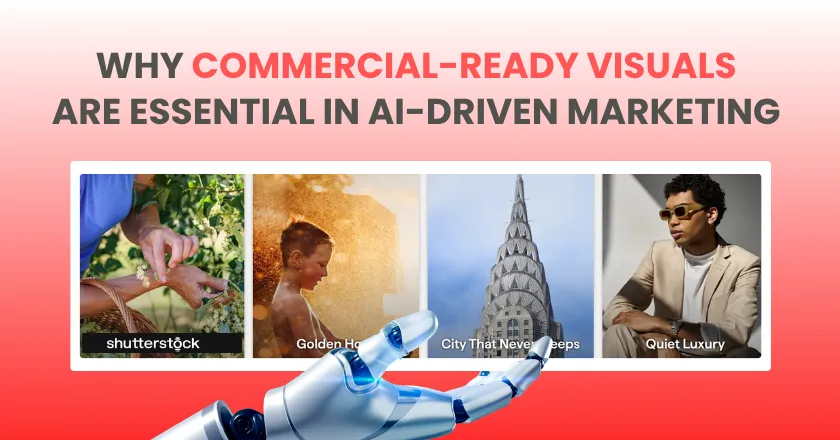
Artificial intelligence has transformed the economics of visual production. Ideas that once required mood boards, design drafts, photography, editing and several rounds of creative development can now be explored within minutes. Marketing teams can test concepts faster, designers can produce more variations, and brands can respond to campaigns, trends and audience behavior with far greater speed than was possible only a few years ago.
That acceleration, however, has created a new challenge. When visual content becomes almost effortless to produce, the question is no longer simply whether a company can create enough images. The more important question is whether those images are suitable for real-world commercial use.
For professional marketing teams, a compelling visual must do more than look good. It needs to fit the brand, work across channels, meet technical requirements, sit comfortably within a broader campaign and come with sufficient clarity around how it can be used. As AI expands the supply of visual content, these practical qualities are becoming increasingly important.
The Creative Problem Has Shifted
Traditionally, visual marketing was constrained by production. A substantial campaign could involve photographers, models, stylists, designers, locations, equipment and post-production before the first set of final assets was ready. Even relatively straightforward campaigns required significant coordination, and producing additional variations often meant additional time and cost.
Stock photography reduced some of that burden by giving companies immediate access to professionally produced material. Generative AI has pushed the efficiency of visual production much further. Marketing teams can now explore several creative directions before committing significant resources, while designers can experiment with different settings, compositions and concepts much earlier in the process.

At the same time, marketing itself has become more demanding. A campaign rarely consists of one image anymore. A single concept may need to appear on a homepage, in paid social, in display advertising, in email, across online marketplaces, inside presentations and in localized versions for multiple countries.
The result is a fundamental shift. Production capacity is no longer always the primary limitation. Instead, teams must manage an abundance of potential material and determine which assets are genuinely ready to represent the brand in public.
Commercial Use Requires More Than Visual Quality
The rapid improvement of generative tools can make this distinction easy to overlook. A highly realistic image can appear perfectly suitable on screen while still requiring closer scrutiny before it becomes part of a commercial campaign.
Professional teams must usually evaluate several dimensions at once. These include:
- Usage rights and licensing: Teams need confidence about where and how an asset can be used.
- Brand alignment: The visual must fit the company's established style, tone and positioning.
- Production quality: Resolution, format, composition and adaptability must meet practical campaign requirements.
- Visual consistency: Images need to work alongside the rest of the campaign rather than feel disconnected.
- Scalability: A strong asset should ideally support different formats, channels and regional versions.
- Content provenance: In increasingly complex workflows, understanding where visual material originated can reduce uncertainty later.
These concerns do not mean that AI-generated content has no place in commercial marketing. Quite the opposite: AI is becoming an important part of creative production. The distinction is that experimentation and deployment are different stages.
An image that works perfectly well during brainstorming may not automatically meet the standards required for a multinational advertising campaign, a corporate website or a long-running brand initiative.
Speed Only Matters When Content Can Be Used
Much of the enthusiasm around AI focuses on production speed. That is understandable. The ability to create dozens of visual concepts in the time it once took to build one can significantly improve creative workflows.
Yet speed becomes less valuable if it creates additional work later. Producing a large number of concepts quickly does not necessarily increase efficiency if teams subsequently need to investigate usage conditions, correct inconsistencies, replace unsuitable material or rebuild assets for different channels.
Commercial readiness is therefore becoming part of the definition of creative efficiency itself. The fastest workflow is not necessarily the one that generates the most material. It is the one that gets suitable material into production with the least friction.
This helps explain why established stock-media ecosystems remain relevant in the AI era. Platforms such as Shutterstock provide extensive collections of professionally produced photography, illustrations, vectors, video and other visual assets within established licensing environments. Instead of beginning every project by resolving basic sourcing questions, marketers can work with content that was created for professional use and then bring AI into the process where it adds the most value.


Stock and AI Are Increasingly Part of the Same Workflow
Discussions about generative AI often treat traditional stock media and AI-created imagery as opposites. In practice, creative teams are increasingly combining them.
A campaign might use AI to explore early concepts, rely on professional photography for the main visual direction, use stock content for supporting assets and then apply AI-assisted editing to adapt the material for different formats. Another team may begin with a professionally produced stock image and use modern editing tools to develop multiple campaign executions around it.
This hybrid approach is likely to become increasingly common because different types of visual content solve different problems. Generative AI is powerful when teams need speed, experimentation and variation. Professional photography and stock media provide strong source material, visual specificity and established commercial workflows.
Rather than forcing marketing departments to choose one or the other, AI is expanding the ways existing visual assets can be used.
A Stock Image Is No Longer Necessarily the Final Product
This shift also changes the role of stock content itself.
In the past, a stock image was often treated as a finished creative asset. A marketer searched for a suitable image, licensed it, added branding or copy and placed it into the campaign. That workflow still works, but modern production is becoming more modular.
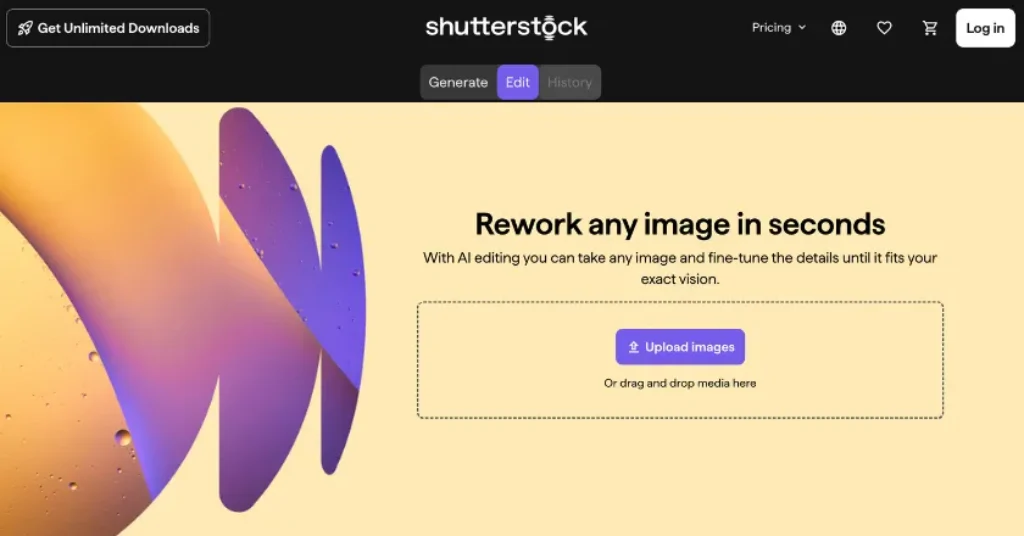
Today, a strong stock image can function as the starting layer of a much broader campaign. Designers can develop multiple crops, integrate it into video, combine it with additional design elements or adapt it to different placements and markets. AI-assisted editing makes these transformations faster and more practical.
That means the value of a professional image no longer depends solely on the original composition. One asset can potentially support multiple creative outputs, reducing the amount of completely new material that needs to be produced.
For large stock libraries such as Shutterstock, this is an important development. Their value is increasingly tied not only to the number of finished images they contain, but also to the number of high-quality creative starting points they provide.

Provenance Becomes More Valuable as Content Becomes Easier to Generate
The explosion of AI-generated imagery has introduced another consideration that receives less attention: provenance.
When visual content was more difficult to produce, companies usually had a clearer understanding of where their assets came from. A photograph came from a photographer, an illustration from an illustrator or studio, and stock content came through a defined platform and licensing process.
AI makes the content supply chain more complex. Images can now come from internal tools, external generators, agencies, individual creators, stock libraries or combinations of several sources.
For a small creative experiment, that complexity may be manageable. For a large organization operating across departments, countries and agencies, it can become an operational issue. Campaigns may involve hundreds of assets and several layers of approval, making clarity around sourcing and usage increasingly valuable.
Established stock platforms have traditionally been built around exactly these processes. As marketing teams work with a wider variety of content sources, that underlying infrastructure may become more useful rather than less.
Brand Consistency Is Harder in an Era of Unlimited Variation
AI is exceptionally good at producing alternatives. It is less naturally suited to maintaining a consistent brand identity without careful direction.
A team can generate several individually strong images that share very little visual DNA. One may be cinematic and highly stylized, another may resemble traditional lifestyle photography, while a third uses a completely different color palette, composition and emotional tone.
Viewed individually, all three might look impressive. Viewed together, they may weaken the identity of the brand.
This matters because strong brands are built partly through visual repetition. Audiences become familiar with a recognizable photographic language, recurring colors, specific environments, particular types of framing and a consistent emotional character.
Professionally curated source material can provide a more stable foundation. A brand can select photography, illustrations or video that already fit a defined creative direction and then use AI to develop variations inside those boundaries. Instead of creating a new visual identity every time someone writes a prompt, AI becomes a tool for scaling an existing one.

The Demand for Fresh Creative Is Growing
Digital advertising has also changed the lifespan of visual content.
Paid-social and display campaigns often need regular creative updates because audiences become accustomed to seeing the same imagery. Even a successful ad can gradually lose effectiveness after repeated exposure, creating continuous pressure to supply fresh assets.
AI makes it easier to produce more variations, but simply increasing volume is not enough. A campaign that changes too aggressively can lose visual coherence.
A more scalable model is to create families of related assets. Teams can preserve common characteristics — such as lighting, composition, visual tone or subject matter — while changing individual elements to keep the campaign fresh.
Professional stock libraries can support this approach by providing related imagery that fits a broader visual direction. AI can then help teams create different crops, placements, formats or localized versions without rebuilding the campaign from the beginning.
This is particularly valuable for performance marketing, where marketers need both consistency and a steady supply of new creative options.
International Campaigns Raise the Stakes Further
Global marketing makes visual production even more complicated. A campaign may have one central idea but require different executions for multiple countries and audiences.
The people, clothing, workplace settings, landscapes or cultural details that resonate in one region may not be equally effective in another. Yet the overall campaign still needs to feel like the work of the same brand.
Dedicated local photography can deliver highly specific material, but producing every regional version independently can become expensive and slow. Generating all local content through AI may be faster, but maintaining the same visual direction across dozens of outputs can be difficult.
Large stock libraries offer a practical middle ground. Teams can identify professional visual material relevant to different regions, industries and audiences while maintaining a common creative framework.
Platforms such as Shutterstock are particularly useful in this environment because their breadth allows global marketers to source different types of content without abandoning the central campaign direction. AI-assisted editing can then help adapt the assets further for specific formats and local requirements.
Professional Photography Still Offers Something Distinctive
The expansion of synthetic imagery has naturally prompted questions about the future of professional photographers, illustrators and videographers. However, commercial visual production is not only about whether an image looks realistic.
Professional creative work contains intent. A photographer controls composition, lighting, timing, subject direction and environment. An illustrator makes deliberate choices about visual language. A videographer shapes movement, pacing and narrative.
Those qualities remain particularly valuable in areas where authenticity and specificity matter, including travel, hospitality, food, lifestyle, corporate communication, product marketing and editorial-style campaigns.
A real location, carefully directed subject or professionally captured event can communicate something different from a purely synthetic image. Stock platforms give marketing teams access to this professional material without requiring every brand to organize each production independently.
AI can then increase the flexibility of those assets rather than replacing their underlying value.
Better Source Material Can Reduce the Need to Generate From Scratch
One of the most important questions for modern creative teams is not whether AI can generate a particular visual. In many cases, it can.
A more useful question is whether generating that visual from scratch is actually the most efficient approach.
If an existing professional image already captures most of the campaign brief — the right subject, lighting, setting and overall tone — the fastest route to the final result may be to start there and adapt it. AI-assisted editing can help close the remaining gap.
This creates a very different model of creative productivity. Instead of starting every project at zero, teams can begin closer to the finish line.
The strongest workflow may therefore combine:
- Professional source material to provide quality, structure and a reliable visual foundation.
- AI-assisted tools to accelerate adaptation, experimentation and variation.
- Human creative direction to maintain strategy, taste and brand consistency.
The three elements are not interchangeable. They address different parts of the production process.
More Content Makes Creative Control More Important
The ability to produce more material quickly can become a liability if companies do not also improve their creative governance.
Imagine several teams independently producing visual assets for the same brand using different AI tools and different prompts. Each result may look professional, yet the company could quickly end up with several competing visual styles appearing across its website, advertising and social media.
This risk grows with scale.
The greater the number of assets a company creates, the more important it becomes to define visual systems that teams can consistently follow. Professional stock content can contribute to these systems by giving marketers a controlled pool of visual material around which adaptations can be built.
AI then supports the production system rather than replacing it.

Starting From Scratch Is Becoming a Choice, Not a Requirement
Creative culture has traditionally associated originality with beginning from a blank canvas. In commercial marketing, however, the final result matters more than the amount of production effort behind it.
A customer does not care whether a campaign image required a multi-day photo shoot, ten hours of editing, a stock asset or an AI-assisted production workflow. What matters is whether the visual captures attention, communicates the message, fits the brand and supports the commercial objective.
That changes the logic of production.
If high-quality material already exists, there is little value in recreating the same foundations simply for the sake of starting from zero. The smarter approach may be to identify the strongest available starting point and focus creative energy on the parts that actually make the campaign distinctive.
Commercial-Ready Visuals Could Gain Value as AI Expands
Generative AI will continue to change the way marketing content is created. Teams will produce more variations, automate more editing tasks and develop campaigns at a pace that would previously have required considerably more resources.
Yet the practical requirements of commercial marketing are not disappearing. Brands still need coherent identities, marketers still need reliable workflows, and campaigns still depend on content that can move from an idea into production without unnecessary friction.
That is why commercially ready visual content may become increasingly valuable as AI adoption grows.
Platforms such as Shutterstock are relevant in this changing environment not simply because they offer finished stock images, but because professional visual libraries can provide the foundation for faster, more adaptable creative workflows. When combined with AI-assisted production and human creative judgment, that foundation can help marketing teams scale content without sacrificing consistency or control.
The future of visual marketing is therefore unlikely to come down to a choice between professional creative work and artificial intelligence. The more likely outcome is a hybrid production model in which each is used where it performs best.
As generating visual content becomes easier, the real advantage may lie in something more difficult to automate: knowing which assets are genuinely ready to represent the brand.
Note: This article was created with the help of AI. The images in this article were generated using AI.






 Stock Photo Guides
 Photo Buyer Guide
 Vector Guru